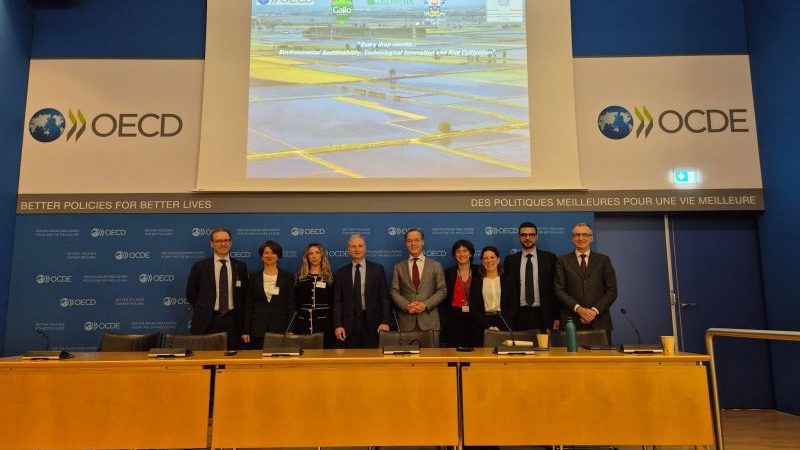
Rice as an advanced indicator of the global climate crisis and increasing pressure on water resources. This was the central theme of the international conference organized by the Italian Permanent Representation, titled “Every drop counts… Environmental Sustainability, Technological Innovation and Rice Cultivation”, held at the OECD headquarters in Paris and dedicated to the future of rice farming in a context of growing water scarcity.
A Strategic Sector Under Pressure
Opening the event, Ambassador Luca Sabbatucci, Permanent Representative to the International Organizations in Paris, highlighted the vulnerability of European agricultural systems, emphasizing Italy’s strategic role as a producer of about 50% of the European Union’s rice.
During the conference, the OECD presented concerning data on the economic outlook linked to water risks. Jaime de Bourbon de Parme, Director for Environment at the organization, stressed how collaboration with Italy is crucial to mitigating the effects of ecosystem degradation. According to OECD analyses, drought is already a structural phenomenon in many parts of the world and, by 2035, could lead to increasing economic losses, with significant impacts on the rice sector in terms of both biomass and yields.
Italy as a Model of Innovation and Resilience
Italy confirms itself as a model of resilience and innovation in water resource management for rice cultivation. This is thanks to the unique configuration of the Po River basin, fed by Alpine waters, and to a long-established and sophisticated irrigation infrastructure.
During the event, several speakers highlighted best practices in sustainable rice farming. Riccardo Preve (Riso Gallo) emphasized the importance of techniques such as dry seeding to reduce water consumption. Meanwhile, Alice Cerutti (Cascina Oschiena) and Maria Chiara Goio (Riso Goio 1929) presented virtuous experiences that combine production quality, biodiversity protection, and environmental sustainability.
A Global Challenge for Food Security
The conference ultimately reinforced that safeguarding rice is not only an agricultural issue but a global food security challenge. In a world where rice is a staple food for about half of the population, ensuring sustainable production will be crucial for the economic and social stability of future generations.